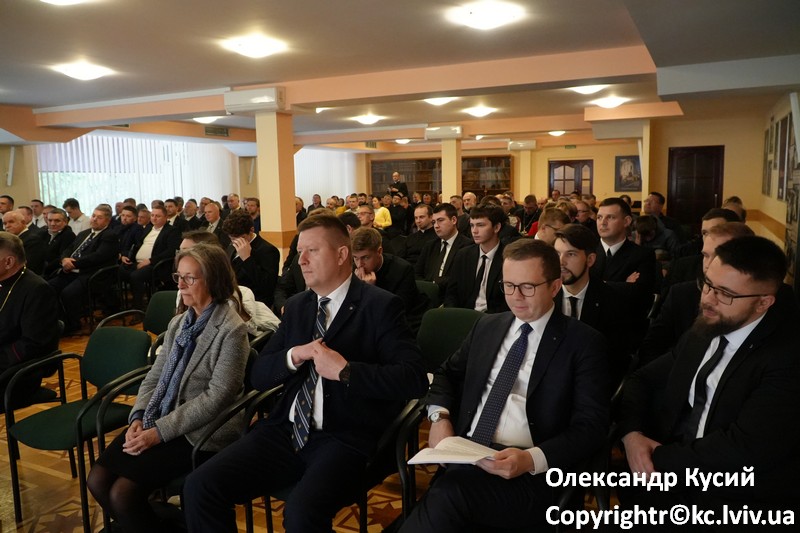
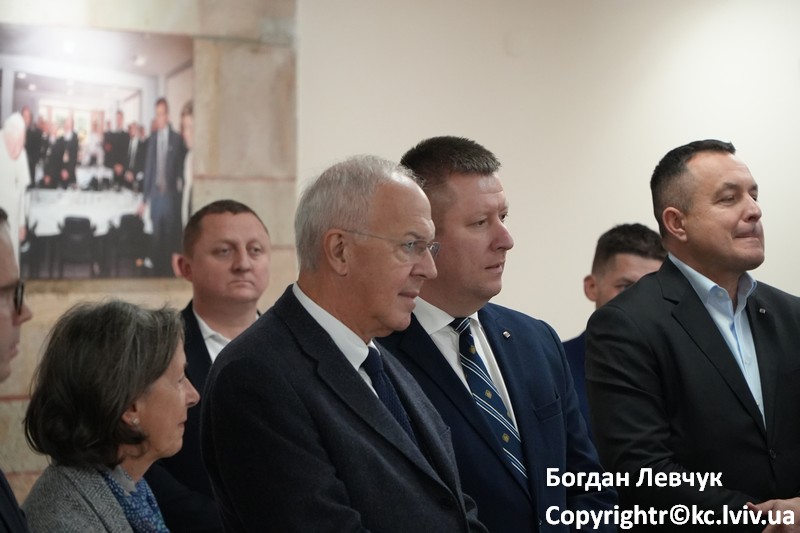
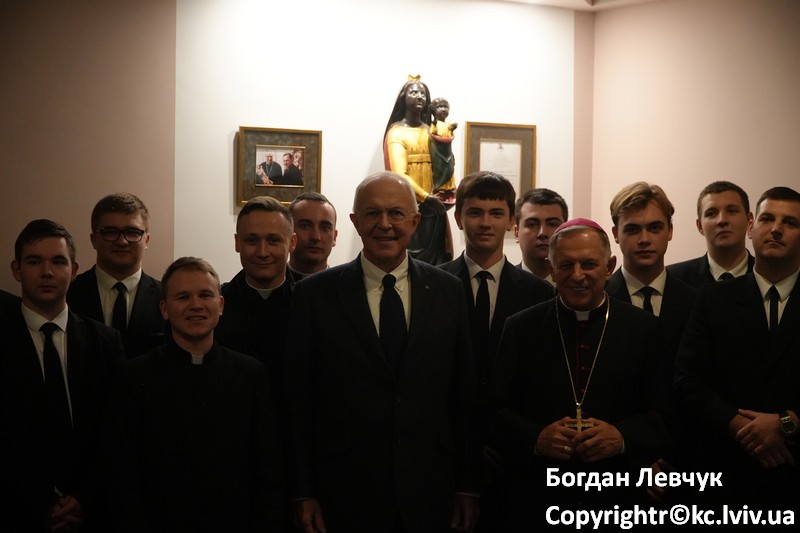
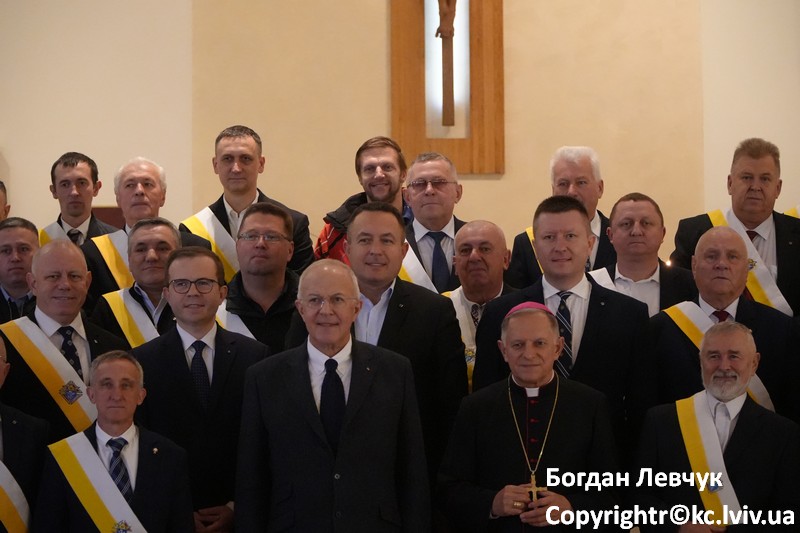
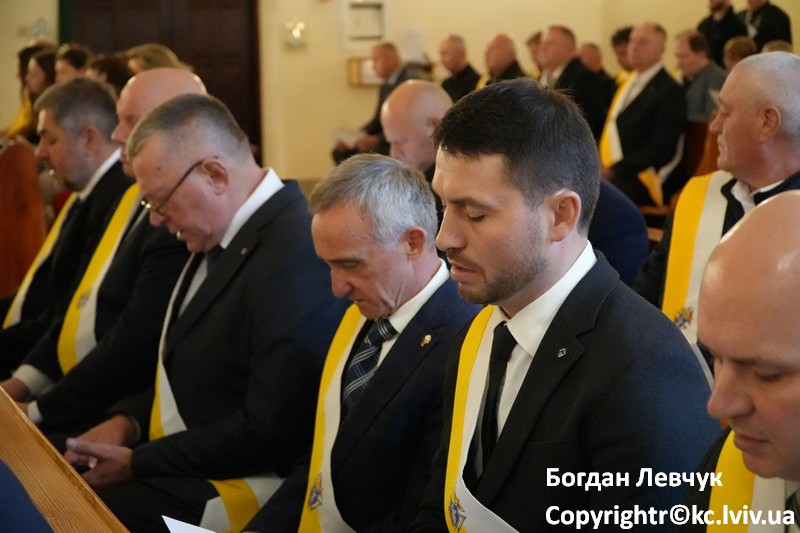
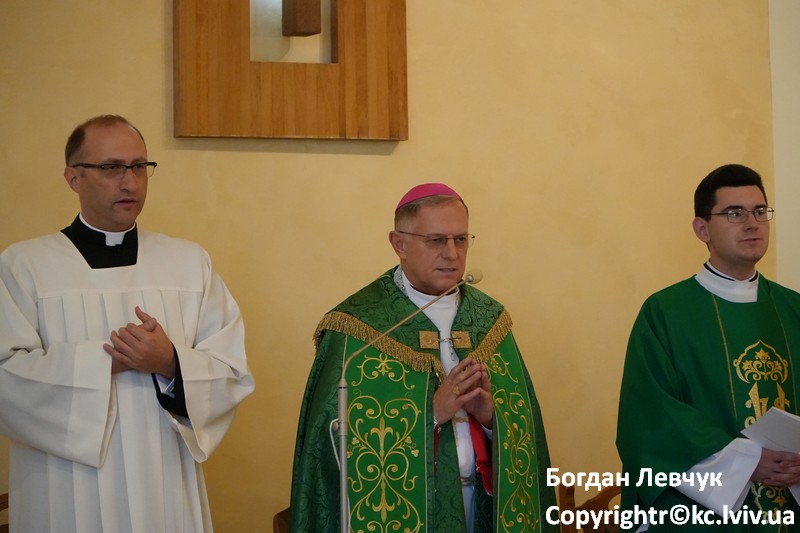
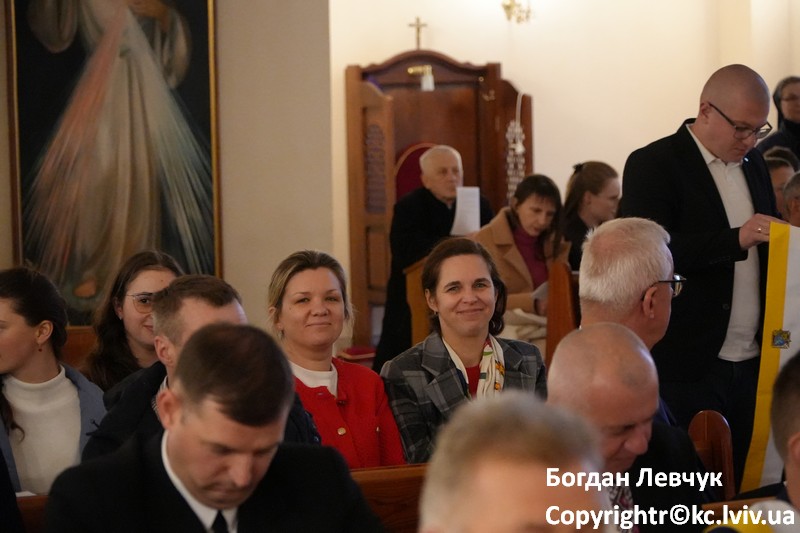
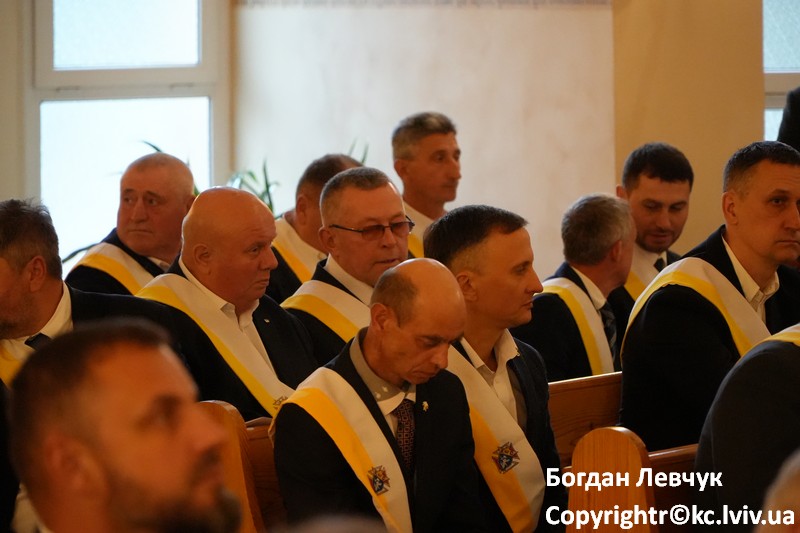
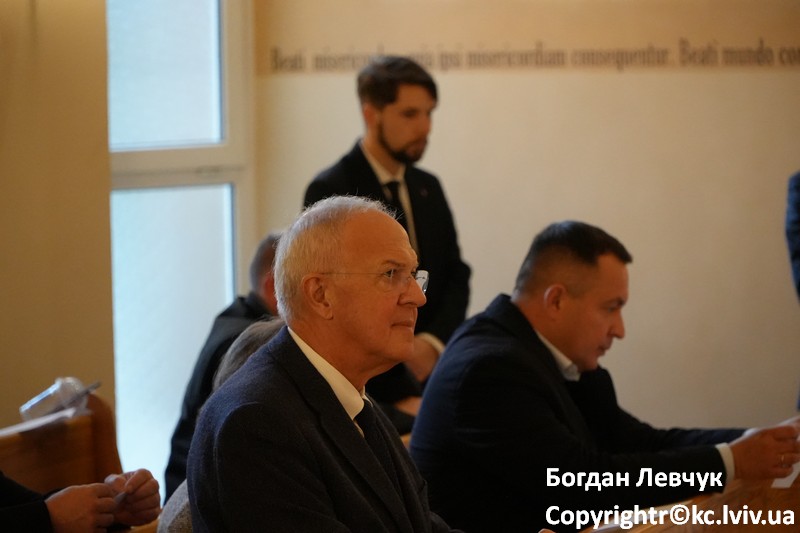
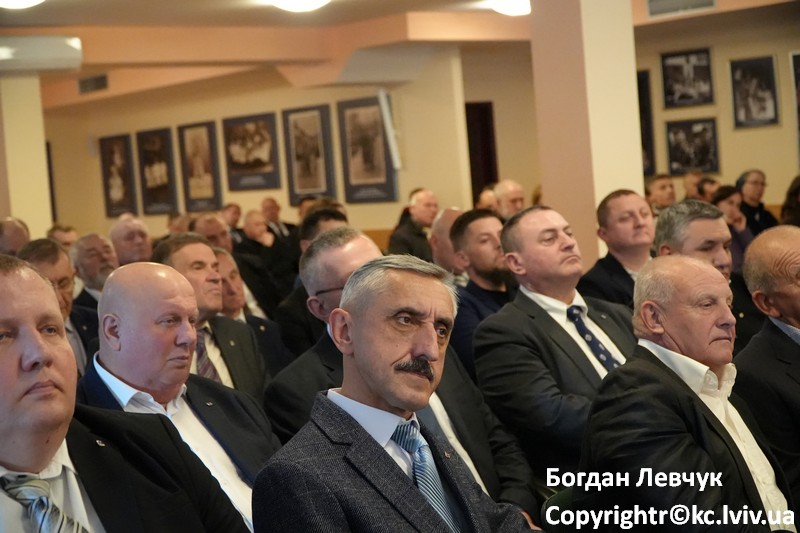
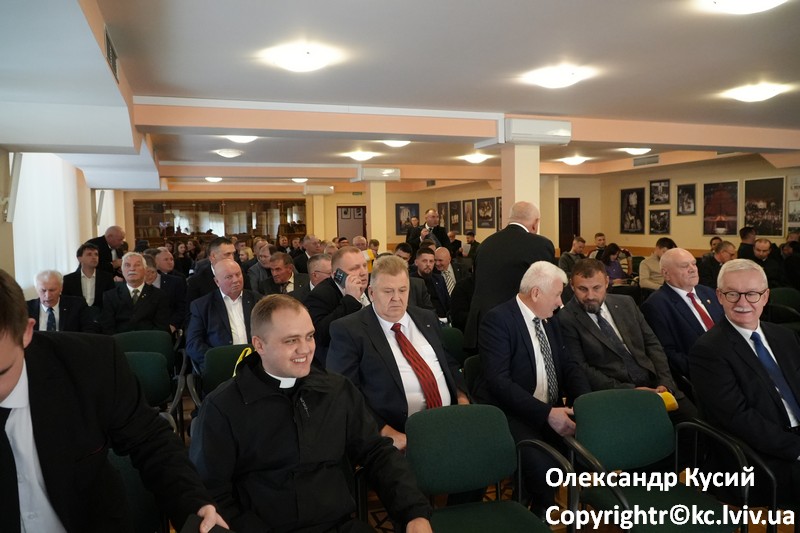
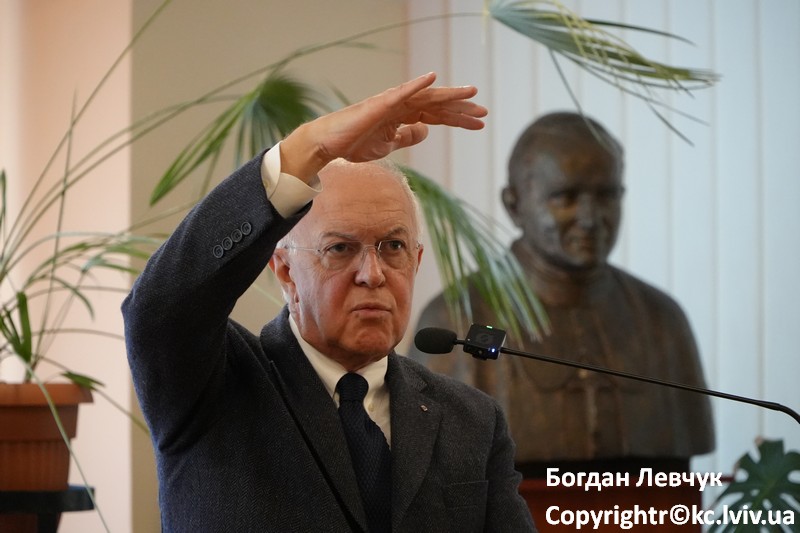
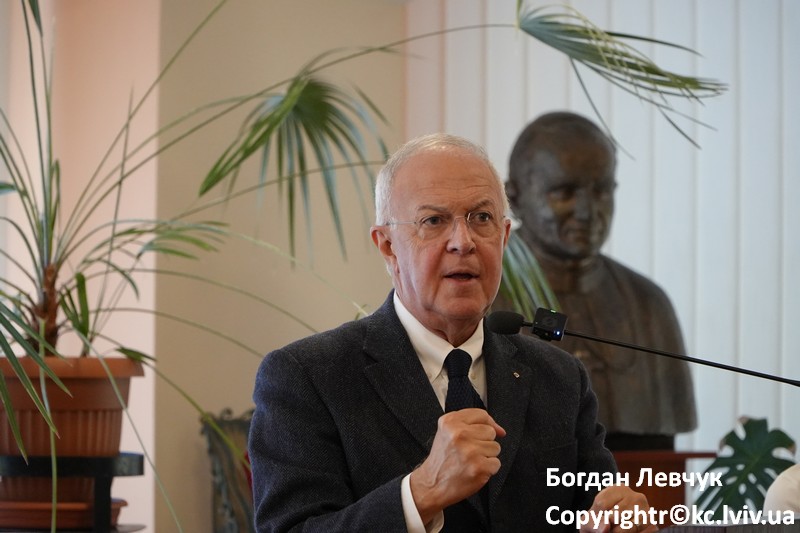
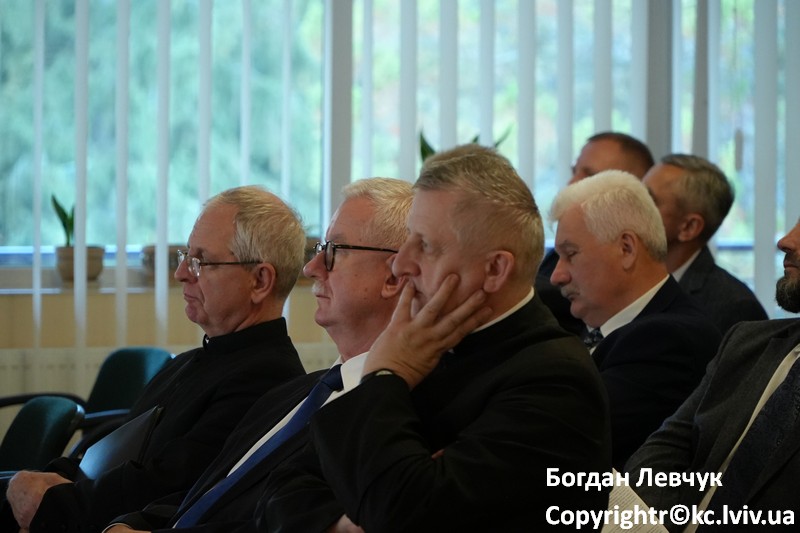
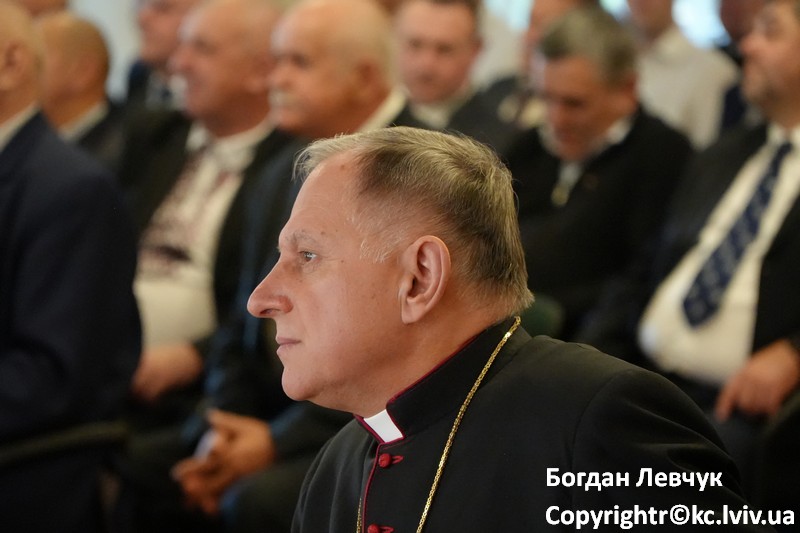
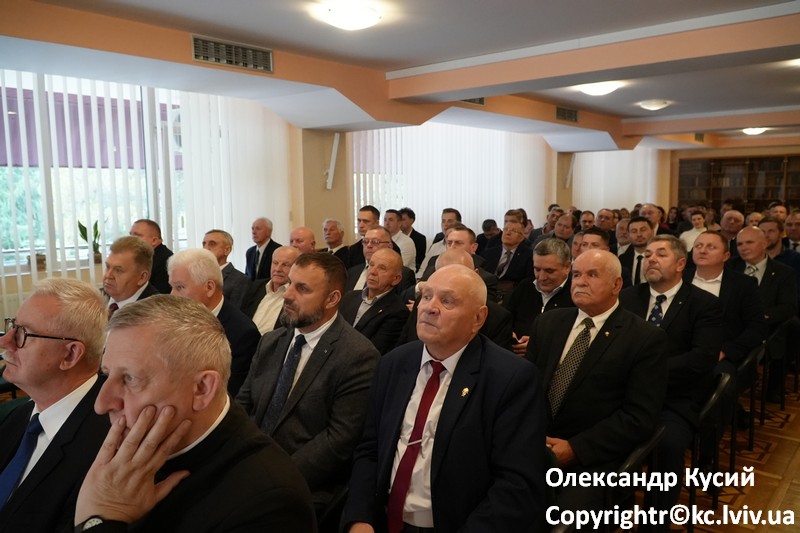
In the evening, October 25, 2025, at the Higher Theological Seminary of St. Joseph in Lviv-Bryukhovychy, former Supreme Knight of Columbus Professor Carl Anderson gave a lecture at the Theological Institute of St. Joseph Bilchevsky, where he addressed seminarians, lay students, and fellow Knights of Columbus who gathered in large numbers in the conference room.
“Today, do not listen to the voices that speak the language of hatred, revenge, retribution... Love life, respect life... Give yourselves to the service of life, not to the cause of death” - These words of Saint John Paul II he reminded the audience.
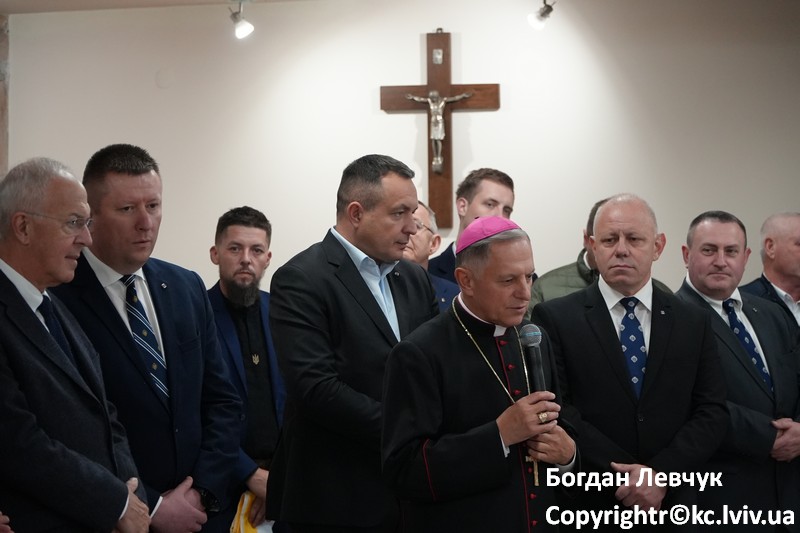
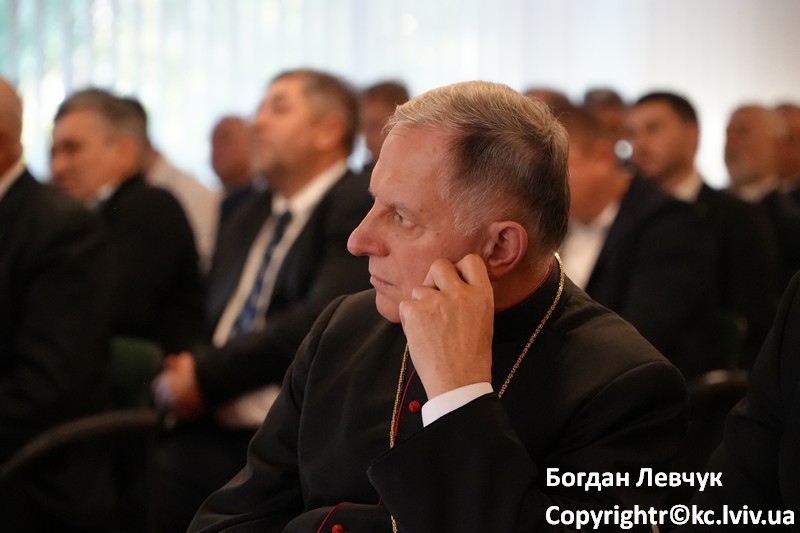
In his greeting, the Archbishop said: “I warmly welcome Mr. Carl Anderson to Ukraine, this week he is lecturing to students at the Catholic University of Lublin and he has also accepted the invitation to come to Lviv, despite the risks of wartime. Professor Anderson intends to share his thoughts, observations and ideas on preserving the memory and teachings of John Paul II, which he is very passionate about.”
The Archbishop expressed deep gratitude to Carl Anderson, noting his exceptional charisma, which he compared to that of John Paul II. He recalled numerous private meetings with Anderson, always listening to him with admiration, and expressed his belief that his speech would make an impression on all present.
After the opening remarks, the director of the institute, Jacek Uliаsz, presented a brief resume of Carl Anderson, after which Professor Anderson addressed the audience:
Repeating the Beginning Again
In 1922, Vladimir Lenin wrote an essay entitled, “On Ascending A High Mountain,” in which he sought to encourage his fellow communists. Although they had recently triumphed in the Russian Civil War, the communists had encountered major setbacks in the new Soviet economic policy and divisions had developed within the Communist International between the Bolsheviks and Mensheviks. But while the essay’s title focused on ascending a mountain it was really about descending a mountain when the forward progress of the climber is no longer possible. It is a particularly instructive analogy and shows how Lenin, no doubt one of history’s most insightful manipulators of cultural change and successful revolutionaries, understood the historical situation in the collapse of European political, economic and cultural stability following the First World War. It also reflects his revolutionary attitude and how he saw what was necessary to continue the process of historical change by building upon what European socialists had already accomplished. It is worth quoting at length.
“Let us picture to ourselves a man ascending a very high, steep and hitherto unexplored mountain. Let us assume that he has overcome unprecedented difficulties and dangers and has succeeded in reaching a much higher point than any of his predecessors, but still has not reached the summit. He finds himself in a position where it is not only difficult and dangerous to proceed in the direction and along the path he has chosen, but positively impossible. He is forced to turn back, descend, seek another path, longer, perhaps, but one that will enable him to reach the summit. The descent from the height that no one before him has reached proves, perhaps, to be more dangerous and difficult for our imaginary traveler than the ascent—it is easier to slip; it is not so easy to choose a foothold; there is not that exhilaration that one feels in going upwards, straight to the goal, etc. .... one has to move at a snail’s pace, and move downwards, descend, away from the goal; and one does not know where this extremely dangerous and painful descent will end, or whether there is a fairly safe detour by which one can ascend more boldly, more quickly and more directly to the summit.”[1]
Lenin’s example, gives us an extraordinary image. And the lesson he draws from it is more extraordinary still. He continues:
“(W)e have kept clear heads and can soberly calculate where, when and how far to retreat (in order to leap further forward); where, when and how to set to work to alter what has remained unfinished. Those Communists are doomed who imagine that it is possible to finish such an epoch-making undertaking as completing the foundations of socialist economy … without making mistakes, without retreats, without numerous alterations to what is unfinished or wrongly done. Communists who have no illusions, who do not give in to despondency, and who preserve their strength and flexibility ‘to begin from the beginning’ over and over again in approaching an extremely difficult task, are not doomed (and in all probability will not perish).”[2]
In his book, Living in the End Times,the contemporary Marxist philosopher Slavoj Zizek, writes this about during Lenin’s essay commenting, “Lenin’s conclusion—“to begin from the beginning over and over again—makes it clear that he is not talking merely of slowing down in order to consolidate what has already been achieved, but precisely of descending to the starting point: one should “begin from the beginning,” not from where one had managed to get to on the previous attempt. In Kierkegaardian terms, the revolutionary process is not a gradual progress, but a repetitive movement, a movement of repeating the beginning again and again.”[3] Zizek reminds us, (unintentionally I assume) with his reference to Kierkegaard the great nineteenth-century Christian existential philosopher and theologian, is that the idea of repeating the beginning again and again, is a Christian insight. Christians are most likely to understand this, of course, in a personal sense. Catholics understand this as part of their sacramental life—in the Eucharistic sacrifice of the Mass and the Sacrament of Reconciliation.
The great American poet, T. S. Eliot explored this idea in his famous poem, The Four Quartets, which comprises a poetic meditation on his own conversion to Christianity:
“We shall not cease from exploration
And the end of all our exploring
Will be to arrive where we started
And know the place for the first time.”[4]
Several years earlier during a lecture at Cambridge University on the future of Christianity, Eliot said, “We need to know how to see the world as the Christian Fathers saw it; and the purpose of reascending to origins is that we should be able to return, with greater spiritual knowledge, to our own situation.”[5]
St. Augustine had put it this way: “By that grace whereby any man becomes a Christian from the commencement of his faith, by the same grace that Man from the beginning was made Christ. By the selfsame Spirit by whose operation He was born, the man is born again.”[6] St. Cyprian had put it more simply: “the Christian is another Christ,” Christianus alter Christus. Commenting on this quotation from St. Cyprian in the context of the fiftieth anniversary of his own priesthood, St. John Paul II observed, “For every priest, in every age, the greatest task is each day to discover his own priestly ‘today’ in the ‘today’ of Christ.”[7]
This was also John Paul II’s commentary on St. Paul’s admonition that “Jesus Christ is the same yesterday and today and forever.”[8] However, St. Paul had not limited this proclamation to the priesthood. It was meant for all believers and so we may take John Paul II’s words about the priesthood and apply them to all Christians. Certainly, the priest in persona Christi (in the person of Christ) in celebrating the sacramentsis an instrument through which Christ acts and thus sacramentally the priest’s “priestly today” is lived in the “today” of Christ through the sacrament of Holy Orders. But there is no reason why the Christian laity cannot also discover each day their own ‘today’ in the ‘today’ of Jesus Christ.
Writing in Gift and Mystery, John Paul II developed this theme more thoroughly saying, “In these fifty years of priestly life, I have come to realize that the Redemption, the price which had to be paid for sin, entails a renewed discovery, a kind of a ‘new creation’ of the whole created order: the rediscovery of man as a person, of man created by God as male and female, a rediscovery of the deepest truth about all man’s works, his culture and civilization, about all his achievements and creative abilities.”[9] The genius of St. John Paul II was his determination to follow this discovery of a new creation in Christ wherever it was to lead—what it means in the life of the believer, but also what it means for the Catholic Church’s encounter with contemporary cultures in the context of a multi-cultural globalization. What does it mean for the individual believer to find his “today” in the “today” of Christ? But more dramatically, what does it mean for each culture to find its “today” in the “today” of Christ?
Those questions were apparent on the very first day of his pontificate. The Scripture reading for John Paul II’s inaugural Mass, included the words of St. Peter, “You are the Christ, the Son of the living God.”[10] Nothing very surprising that the successor of St. Peter would begin his ministry repeating St. Peter’s proclamation of Jesus Christ as the Messiah. But what might have seemed surprising is that the new pope proclaims them with the angelic salutation addressed to the Blessed Virgin Mary and later to St. Joseph— “Do not be afraid.” After nearly 2,000 years of Christianity, the pope warns us, not to be afraid of Christ as the Messiah. But afraid of what? These words of St. Peter which virtually every Christian has heard, and that Catholics especially have heard so often have become in a way routine and commonplace. After two thousand years of Christianity what reason could there be to be afraid of hearing again St. Peter’s declaration that Jesus is the Messiah?
John Paul II will explain the radical meaning he gives to this proclamation and its consequence for the entirety of his pontificate—a pontificate that would repeat this beginning again and again. John Paul II began his pontificate with the proclamation that Jesus is truly the Christ, the Son of the living God. In his homily, that proclamation could have been developed in a variety of ways. But John Paul II takes it in a decisively cultural dimension and the consequences of this proclamation for society. “Open wide the doors for Christ. To his saving power open the boundaries of States, economic and political systems, the vast fields of culture, civilization and development. Do not be afraid. Christ knows ‘what is in man.’ He alone knows it.”[11]
Certainly, John Paul II was thinking of Poland. That would be made very clear, very soon. During the next 27 years, however, it would be clear that he was also thinking of each of the 129 countries he would visit. He excluded no one from his mission to “let Christ speak to man.” Christ “alone has words of life.” And it was the pope’s mission that “Christ’s words of life may reach all people.”[12] In the Western democracies, it was easy to see John Paul II’s statement to “Open wide the doors for Christ” as a call for religious freedom in countries where communist regimes had slammed shut its doors to Christianity. But he was thinking not only of liberty. He was thinking about freedom and its relation to truth—Christ alone knows what is the truth about man.
With the angelic salutation: “Do not be afraid,” he announced a new evangelical engagement with societies around the world based upon a Christian anthropology from which Christology was inseparable.[13] This Christological anthropology provides the coherent frame of reference for the pope’s mission and his inaugural homily is the foretaste of what would come throughout his pontificate as did his pilgrimages to Mexico, Poland, Ireland and the United States during his first year as pope. It was not only a challenge to communist regimes but to every culture and political system.
Two months after being elected pope and telling the world not to be afraid of Christ, John Paul II announced he would travel to Mexico. One month later, he was in Mexico City praying before the miraculous image of Our Lady of Guadalupe. As the starting point for a new global evangelization, Mexico was an inspired choice. A devotedly Catholic country, Mexico had, earlier in the century, suffered a persecution of the Catholic Church that had resulted in thousands of refugees crossing into the United States, the destruction of churches and Catholic institutions and the killing of nearly 100 priests and countless laymen. In 1978, the Catholic Church continued to suffer serious deprivations of basic civil liberties. The pope’s challenge to open wide the doors to Christ could not be missed by the political leaders of Mexico’s “revolutionary” political party (Partido Revolucionario Institucional) that had governed the country for more than half a century and had been responsible variously for the persecution of the Catholic Church that had been condemned by Pope Pius XI in two encyclicals on the situation in that nation: Iniquis Afflictisque[14] (Unjust Afflictions) and Acerba Animi[15] (Harsh Souls). That political regime still insisted on maintaining a constitutional framework that disadvantaged the Catholic Church as a second-class institution.
Many observers considered the pope’s visit to Our Lady of Guadalupe as routine because of his devotion to the Blessed Virgin Mary. But it was more than that. It was a key to understanding his entire global ministry in two important ways. First, the “mestiza face” of Our Lady of Guadalupe was, as John Paul II would later write, “an impressive example of a perfectly enculturated evangelization.”[16] Throughout his pontificate, John Paul II would not seek to evangelize solely from the outside, as if Christianity were some type of European import—his proposal for a new evangelization would be an “enculturated” evangelization. This was especially true in countries where the Catholic faith had been lived for centuries. He would often speak of the need for a “new” evangelization—one that would in some sense re-introduce Christianity to a society that in some sense had begun to tire of the Christian message or rejected it.
Second, Our Lady of Guadalupe symbolized what John Paul II meant when he spoke of opening wide the doors to Christ. He was not seeking to impose something from the outside, Christianity had already been formative of Mexican culture for nearly five centuries. In this sense, Christ was already within Mexican culture. It was the secularists who were seeking to drive Him out. This was a theme he would soon take up again with even greater urgency during his first pilgrimage to Poland and in his homily in Warsaw’s Victory Square.
The most dramatic demonstration of what John Paul II meant when he said nations must “open wide their doors for Christ” did not come in Mexico City, the center of Mexican political power, but at the margins of power—among the indigenous tribes from the poorest regions of Mexico: Oaxaca and Chiapas.
In St. Peter’s Square, John Paul II had said that “Christ knows what is in man, only he knows it.”
At the village of Cuilapan, John Paul II declared his identification with the poorest of Mexico’s poor saying that in the Church “there can be no distinction of race or culture,” he continued, “The Pope and the Church are with you and love you: they love your persons, your culture, your traditions; they admire your marvelous past, they encourage you in the present and they hope so much for the future.” would be “the voice of those who cannot speak or who are silenced.” He insisted that, “The worker who with his sweat waters also his affliction, cannot wait any longer for full and effective recognition of his dignity, which is not inferior to that of any other social sector. He has the right to be respected.… He has the right to … have access to the development that his dignity as a man and as a son of God deserves… It is necessary to carry out bold changes.’”[17]
Opening wide the doors for Christ meant seeing Christ in the indigenous and in building a society that respects the dignity of those on the margins. This was an essential element to the beginning of Christianity in Mexico. Our Lady of Guadalupe had appeared to an indigenous, Juan Diego Cuauhtlatoatzin, had spoken to him in his indigenous language and who appeared on his venerated tilma resplendent with native religious symbolism.[18] In Mexico, John Paul II made clear that “opening wide the doors for Christ” would not only be a matter of preaching—of evangelization, whether old or new—but also a matter of presenting the Catholic proposal for fundamental principles of social justice.
The late American theologian Avery Dulles has described John Paul II’s vision regarding the demands of the Gospel in challenging the cultural assumptions of society: “Western European culture, in spite of its past greatness, no longer suffices for a world Church. Every cultural sector, including those of Asia and Africa, has a proper contribution to make in showing forth the full riches of Christ the redeemer. By implanting itself in various cultures, the gospel preserves, elevates, and purifies those cultures, supplementing whatever may be lacking in them… the Church hears a call to evangelize not only individuals but cultures themselves. In so doing, the Church and its representatives must not fear to become signs of contradiction.”[19] Easy enough to understand in terms of Asia and Africa, but what about the United States? Are we to say that there is no longer a need for the Gospel to elevate and purify European and American culture? And if the need continues to exist, what exactly are we to do about it? That would also become clear in the first year of the John Paul II’s pontificate.
Four months to the day that he departed Mexico, John Paul II arrived in Warsaw to begin nine days that would change the world. Much has been written about his papal pilgrimage to Poland especially from the standpoint of its political impact and the creation of the Solidarity movement. But the political change was preceded by something more fundamental. Timothy Garton Ash in his history, The Polish Revolution: Solidarity, stated that he had not found a better phrase to describe “what changed in the everyday lives of millions of Poles” in 1981 than what a factory worker from Poznan had told him. “You see,” he said, “it is a revolution of the soul.”[20]
Consider these words from his homily in Victory Square: “To Poland the Church brought Christ, the key to understanding that great and fundamental reality that is man. For man cannot be fully understood without Christ. He cannot understand who he is, nor what his true dignity is, nor what his vocation is, nor what his final end is. He cannot understand any of this without Christ.” The pope’s homily in Victory Square was in reality the sequel to what he had said in St. Peter’s Square. “Therefore,” the pope continued, “Christ cannot be kept out of the history of man in any part of the globe, at any longitude or latitude or geography. The exclusion of Christ from the history of man is an act against man. Without Christ it is impossible to understand the history of Poland….”[21]
For a Marxist regime based on exclusion of the false consciousness of Christianity as the precondition of progress, it is difficult to imagine a greater challenge than what John Paul II said in Warsaw. The pope had taken aim at the center of Marxist theory. But not in a theoretical or abstract way. It was a challenge arising from the actual historical experience of the Polish people. Many in the West were astounded the pope had declared a new Ostpolitik. But the mistake was to think that what he said was limited to Poland and even to those nations behind the Iron Curtain—in other words, there is no reason to conclude that these words were only to be understood in the context of Ostpolitik. His words apply with equal force to the secularized liberal democracies of the West that sought in one way or another to marginalize and privatize Christianity—democracies in which it has become normative to disregard Christianity.
Four months after his triumphant visit to Poland, John Paul II would again cross the Atlantic for the first of his five pastoral visits to the United States. On the way he would stop in Ireland for a message that would change the course of history in that country. Throughout 1979, Northern Ireland had witnessed horrific sectarian violence. Just weeks before the pope’s arrival, the Provisional Irish Republican Army killed 18 British soldiers in Northern Ireland. On the same day a bomb killed 79-year-old Lord Louis Mountbatten and his grandson. The Provisional IRA claimed responsibility for what they described as his “execution” as well.
British Prime Minister Margaret Thatcher had warned that Northern Ireland was in danger of becoming another Balkans, “Distrust mounting to hatred and revenge is never far beneath the political surface,” she said. “And those who step onto it must do so gingerly.”[22] Pope John Paul II was about to do just that. But not gingerly. The pope had considered going to Northern Ireland, but the recent violence now made that impossible. Instead, the pope chose the coastal town of Drogheda close to Northern Ireland. It was a site seared into the memory of Irish Catholics. There in 1649, Oliver Cromwell’s Protestant English army had committed the bloodiest massacre of Catholics in Irish history. And there in 1979, John Paul II preached a homily of reconciliation and forgiveness.
If his impassioned addresses in Cuilapan and Warsaw had been historic, John Paul II’s homily during his Mass for youth in Drogheda was equally so. It was followed by 14 minutes of uninterrupted applause. “Christianity does not command us to close our eyes to difficult human problems,” he declared. But “What Christianity does forbid is to seek solutions to these situations by the ways of hatred, by the murdering of defenseless people, by the methods of terrorism.” He continued, “the message I affirmed in Mexico and Poland. I reaffirm it here in Ireland. Every human being has inalienable rights that must be respected.… The moral law, guardian of human rights, protector of the dignity of man, cannot be set aside by any person or group, or by the State itself, for any cause, not even for security or in the interests of law and order. The law of God stands in judgment over all reasons of State.”
Then he addressed what had become part of Irish national life. “I proclaim,” he said, “that violence is evil, that violence is unacceptable as a solution to problems, that violence is unworthy of man. Violence is a lie, for it goes against the truth of our faith, the truth of our humanity.” Then the pope pleaded, “On my knees I beg you to turn away from the paths of violence and to return to the ways of peace.” And to the youth of Ireland he said, “do not listen to voices which speak the language of hatred, revenge, retaliation…. Love life, respect life…. Give yourselves to the service of life, not the work of death.”[23]
It would still be years before the Downing Street Declaration and Good Friday Agreement. But John Paul II had set a tipping-point and altered the national consciousness—endless violence was no longer inevitable. Protestants in Northern Ireland, hearing the pope’s passionate condemnation of violence, now knew suspicions that the Catholic Church was secretly supporting terrorism were unfounded. And the dramatic response of Catholics also sent a message. Decades earlier, Mao Tse-Tung had said of the Chinese communists that the guerrilla fighter moves through the civilian population like fish swim in the sea. By their applause, Catholics had announced that the sea was drying up for terrorists. In Poland, John Paul II promoted a new solidarity—what Jozef Tischner described as a solidarity of “awakened consciences.”[24] He had now done something similar in Ireland.
Then John Paul II departed for Boston where later that same day he would celebrate Mass for more than two million Catholics—the largest religious gathering in the history of the United States. What awaited him in the United States was in some ways even more unexpected than what had happened in Mexico, Poland and Ireland. For generations, Catholics in the United States had been an unpopular minority caught between the cultural millstones of Protestantism and secularism. Like many Catholics in Western Europe, Catholics in the United States had been shocked by the reaction to Pope Paul VI’s Humanae Vitae.[25] But in the United States, Protestants and secularists came together in their denunciation of the pope. Even today, it is difficult to imagine the tsunami of protest that greeted the encyclical. In the decade that followed, Pope Paul VI was seen increasingly as frail, isolated, and elderly—a shepherd out of touch with his flock and leading an institution in disarray. The primary reason for the John Paul II’s trip to the United States was to address the United Nations. On October 2nd John Paul II flew to New York. There for approximately an hour he addressed the world’s diplomats, emphasizing their responsibility to safeguard the rights of the human person—including what he called “the objective rights of the spirit, of human conscience and of human creativity, including man’s relationship with God.”[26]
The pope’s last stop was Washington, D.C. where he met privately with President Jimmy Carter at the White House. Carter had asked the pope at the beginning of their meeting whether it would be “official.” John Paul II responded that it should be an informal meeting, they could speak in English without interpreters and the White House and Vatican staff members left the room. President Carter’s personal handwritten notes of the meeting are the only record of what the two men discussed. Later at the White House Carter had been gracious, saying: “You have moved among us as a champion of dignity and decency for every human being, and as a pilgrim for peace among nations. You have offered us your love, and we as individuals are heartened by it. You can be sure, Pope John Paul, that the people of America return your love.”[27] From the White House, the pope went to the Washington Mall to celebrate Mass.
Since the seventeenth-century, Catholics in the United States had coexisted with a persistent form of anti-Catholicism which historian Philip Jenkins has described as the last acceptable prejudice in America.[28] What fueled that prejudice was a firm conviction held by both Protestants and secularists that Catholics, and especially the pope, should be denied political influence or power. John F. Kennedy, America’s first Catholic president, had had to overcome suspicions that the pope would secretly tell him what to do. In the presidential campaign of 1960, Kennedy had promised a gathering of Protestant ministers that, “I am not the Catholic candidate for President. I am the Democratic Party’s candidate for President who happens also to be a Catholic. I do not speak for my church on public matters—and the church does not speak for me.”[29]
John Paul II had just addressed the world’s governments at the United Nations. His agenda on behalf of human rights was a very public one. Now on the Mall in Washington, he would change how Americans viewed the pope and how Catholics viewed their responsibilities as citizens. He did so by entering the public debate on one of the nation’s most divisive issues—abortion. He said, “I do not hesitate to proclaim before you and the world that all human life—from the moment of conception and through all subsequent stages—is sacred, because human life is created in the image and likeness of God. Nothing surpasses the greatness or dignity of a human person…. And so,” he continued, “we will stand up every time that human life is threatened. When the sacredness of life before birth is attacked, we will stand up and proclaim that no one ever has the authority to destroy unborn life.”[30] American Catholics had been charged to build what he would later describe as a culture of life and a civilization of love. If before John Paul came to the United States the papacy appeared in disarray, after his visit that was no longer the case. Time magazine placed a photograph of the pope on its cover with the headline, “John Paul, Superstar.”[31]
In less than a week, John Paul II had not only restored the image of the pope, he had brought a new unity among millions of Catholics with the pope and he had energized Catholics in the pro-life movement in America. With those words, “we will stand up” it seemed as those a line had been drawn on the Mall in Washington that the cultural retreat of the Catholic Church had been experiencing in regard to issues affecting marriage, family and procreation had ended; a new era for Catholics in the United States had begun through the leadership of a pope with confidence and firm conviction.Within a year of his election as pope, John Paul II had shown the world what he meant when he had said, “Open wide the doors for Christ” in the fields of economics, politics, and culture. He had championed social justice for the marginalized in the Third World, spoken of religious liberty and human rights for those suffering totalitarian oppression, sought a new reconciliation to overcome the centuries-old divisions within Christianity, outlined a global human rights agenda among the world’s diplomats, and found a new voice for Catholicism within the public debate of secular, liberal democracies.
All of this was showing the world what John Paul II had meant when in his first homily as pope he had said, “Do not be afraid. Open wide the doors for Christ.”
[1] V. I. Lenin, “On Ascending A High Mountain,” Collected Works, Volume 33, second English edition, edited and translated by David Skvirsky and George Hanna (Moscow: Progress Publishers, 1973), 204.
[2] Ibid., 207.
[3] Slavou Zizek, Living in the End Times (London: Verso, 2010), 459.
[4] T. S. Eliot, The Complete Poems and Plays 1909-1950 (New York: Harcourt Brace and Company, 1950), 145.
[5] T. S. Eliot, The Idea of a Christian Society (New York: Harcourt, Brace and Company, 1940), 63
[6] Quoted in S. M. Giraud, The Spirit of Sacrifice and the Life of Sacrifice in the Religious State, revised by Herbert Thurston (New York: Benziger Brothers, 1905), 24.
[7] John Paul II, Gift and Mystery: On the Fiftieth Anniversary of My Priestly Ordination (New York, Doubleday, 1996), 84.
[8] Hebrews 13:8.
[9] Ibid., 82.
[10] Matthew 16:16.
[11] John Paul II, Homily for Inauguration of Pontificate, October 22, 1978, https://www.vatican.va.
[12] Ibid.
[13] Joseph Ratzinger, “The Faith is Humanity’s Refuge: The Fourteen Encyclicals of John Paul II,” Communio, Italian edition (July-August, 2003), 8-16; reprinted in Joseph Ratzinger/Benedict XVI, John Paul II: My Beloved Predecessor, editor, Elio Guerriero (Boston: Pauline Books and Media, 2007), 33.
[14] Pius XI, Iniquis Afflectisque, November 18, 1926, https://www.vatican.va.
[15] Pius XI, Acerba Animi, September 29, 1932, https://www.vatican.va.
[16] John Paul II, Ecclesia in America, 11, January 22, 1999, https://www.vatican.va.
[17] George Weigel, Witness to Hope: The Biography of Pope John Paul II (New York: Cliff Street Books, 1999), 186.
[18] Carl Anderson and Eduardo Chavez, Our Lady of Guadalupe: Mother of the Civilization of Love (New York: Doubleday, 2009).
[19] Avery Dulles, “John Paul II Theologian,” Communio 24 (1997): 713-27 at 719.
[20] Timothy Garton Ash, The Polish Revolution: Solidarity (New York: Charles Scribner’s Sons, 1984), 278.
[21] John Paul II, Homily of His Holiness at Victory Square (June 2, 1979).
[22] Margaret Thatcher, The Downing Street Years (New York: Harper Collins, 1993), 385.
[23] John Paul II, Homily at the Holy Mass in Drogheda,September 29, 1979, https://www.vatican.va.
[24] Cited in Timothy Garton Ash, The Polish Revolution (New York: Scribner, 1984), 280.
[25] Paul VI, Humanae Vitae, July 25, 1968, https://www.vatican.va.
[26] John Paul II, Address to the 34th General Assembly of the United Nations, October 2, 1979, https://www.vatican.va.
[27] “The Pope in America,” op. cit.
[28] Philip Jenkins, The New Anti-Catholicism: The Last Acceptable Prejudice (Oxford: Oxford University Press, 2003).
[29] John F. Kennedy, Address to the Greater Houston Ministerial Association, September 12, 1960, IFP-140, JFKLibrary.org.
[30] John Paul II, Homily at the Holy Mass at the Capital Mall, October 7, 1979, https://www.vatican.va.
[31] “The Pope in America,” op. cit.
Author : Oleksandr Kusyy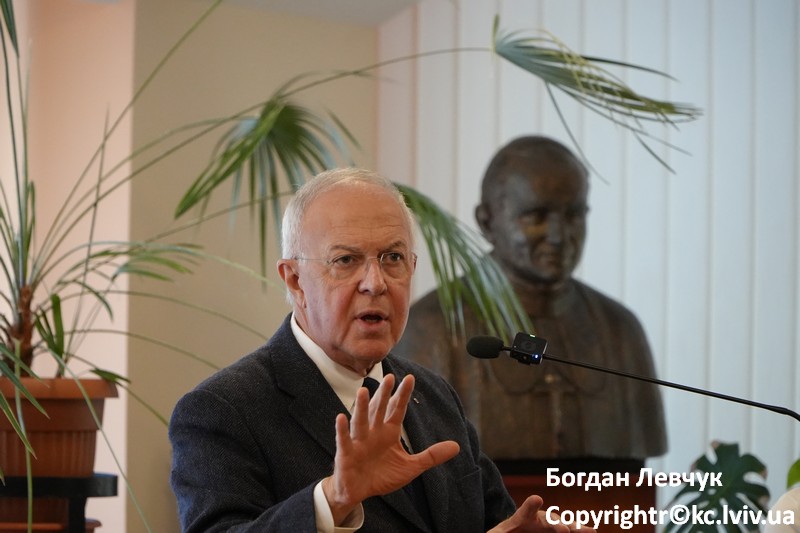




© Copyright © 1991-2025 Roman Catholic Archdiocese of Lviv.
All rights reserved. Complete or partial use of materials is allowed provided the link www. rkc.lviv.ua (reprinted Internet - a hyperlink www. rkc.lviv.ua). Responsibility for the accuracy of the facts, quotes, names and other information lies with the authors of publications. The editors reserve the right to edit submitted materials.
If you notice an error, highlight it and press Ctrl + Enter to inform the editorial staff.


